I Am the Change: Barack Obama and the Crisis of Liberalism by Charles R. Kesler
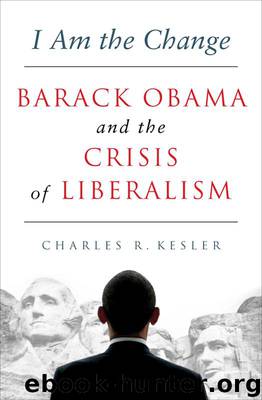
Author:Charles R. Kesler
Language: eng
Format: mobi, epub
Tags: Political Science, General
ISBN: 9780062072979
Publisher: HarperCollins
Published: 2012-09-11T00:00:00+00:00
4
Lyndon B. Johnson and the Politics of Meaning
Barack Obama is a child of the Sixties, born in 1961, the same year that the word lifestyle entered Webster’s Dictionary. By most definitions, he’s a baby boomer, though he hasn’t dwelled on that status and sometimes seems to reject it. “In the back-and-forth between Clinton and Gingrich, and in the elections of 2000 and 2004,” he writes in The Audacity of Hope, “I sometimes felt as if I were watching the psychodrama of the Baby Boom generation—a tale rooted in old grudges and revenge plots hatched on a handful of college campuses long ago—played out on the national stage.” As a late boomer, Obama is much younger than Clinton, born in 1946, and Gingrich, born in 1943, and obviously didn’t attend college in the 1960s, as they did. In addition, he has substantive reasons for wanting to distance himself from the “grudges and revenge plots” born in that decade. “The victories that the sixties generation brought about—the admission of minorities and women into full citizenship, the strengthening of individual liberties and the healthy willingness to question authority—have made America a far better place for all her citizens,” he affirms. But “those shared assumptions . . . that bring us together as Americans” were lost in the process and have not been replaced.1
In one sense, as he admits, he’s “a pure product of that era.” As “the child of a mixed marriage,” his opportunities would have been “entirely foreclosed” without the “social upheavals” of those years. At the time he was too young to understand that, but as an adolescent in the 1970s he connected to the Sixties firsthand through his own rebellion. “I became fascinated with the Dionysian, up-for-grabs quality of the era, and through books, film, and music,” and eventually marijuana and cocaine, he reenacted the Sixties in his own life. His Sixties was not the Peace Corps and Freedom Rides, but “Huey Newton, the ’68 Democratic National Convention, the Saigon airlift, and the Stones at Altamont.” In college, he says, he began to see “how any challenge to convention harbored within it the possibility of its own excesses and its own orthodoxy,” and so he reexamined his “assumptions” and discovered the pleasures of the Apollonian. His own experience left him, however, with a sense of the lasting difference the Sixties had made in American politics.
Despite a forty-year remove, the tumult of the sixties and the subsequent backlash continues to drive our political discourse. Partly it underscores how deeply felt the conflicts of the sixties must have been for the men and women who came of age at that time, and the degree to which the arguments of the era were understood not simply as political disputes but as individual choices that defined personal identity and moral standing.
I suppose it also highlights the fact that the flash-point issues of the sixties were never fully resolved. The fury of the counterculture may have dissipated into consumerism, lifestyle choices, and musical preferences rather
Download
I Am the Change: Barack Obama and the Crisis of Liberalism by Charles R. Kesler.epub
This site does not store any files on its server. We only index and link to content provided by other sites. Please contact the content providers to delete copyright contents if any and email us, we'll remove relevant links or contents immediately.
| Anthropology | Archaeology |
| Philosophy | Politics & Government |
| Social Sciences | Sociology |
| Women's Studies |
The Secret History by Donna Tartt(18996)
The Social Justice Warrior Handbook by Lisa De Pasquale(12176)
Thirteen Reasons Why by Jay Asher(8873)
This Is How You Lose Her by Junot Diaz(6855)
Weapons of Math Destruction by Cathy O'Neil(6248)
Zero to One by Peter Thiel(5762)
Beartown by Fredrik Backman(5707)
The Myth of the Strong Leader by Archie Brown(5479)
The Fire Next Time by James Baldwin(5409)
How Democracies Die by Steven Levitsky & Daniel Ziblatt(5199)
Promise Me, Dad by Joe Biden(5127)
Stone's Rules by Roger Stone(5065)
A Higher Loyalty: Truth, Lies, and Leadership by James Comey(4937)
100 Deadly Skills by Clint Emerson(4898)
Rise and Kill First by Ronen Bergman(4757)
Secrecy World by Jake Bernstein(4725)
The David Icke Guide to the Global Conspiracy (and how to end it) by David Icke(4682)
The Farm by Tom Rob Smith(4484)
The Doomsday Machine by Daniel Ellsberg(4472)
